
Crown & Bridge

Crown is a fixed dental prosthesis used to restore a damaged tooth or cover an implant. It resembles the lost, damaged or missing tooth and helps in restoring its shape, size and function. Bridges on other hand are fixed dental prosthesis used to replace one or more missing teeth by joining fabricated teeth with adjacent teeth or implant.

A dental crown may be required to protect a weak tooth from breakage, to restore an already broken tooth, to cover and support a tooth with a large filling, to cover misshaped or severely discoloured teeth, to cover severely attrited tooth, to cover a dental implant or to make a cosmetic modification.

Cons with Metal Crowns:
In recent time, magnetic resonance imaging (MRI), has become a common medical diagnostic imaging tool. Since it uses powerful magnetic fields to create images of the inside of the body, there have been concerns about the safety of metal objects like fillings, implants, and crowns in patient’s mouths. A few different factors determine if dental crowns and MRI are a bad combination.
Even if a crown is not pulled out, it can still be damaged. The strong magnetic field of the MRI machine can interact with the metal, causing it to vibrate. This vibration can move, bend, or break dental restorations. Even if a certain metal isn’t attracted to a magnet, it can still pose a danger. Some metals absorb the energy created by the magnetic field. This energy can heat the metal enough to cause burns on the surrounding tissue in the mouth.

Following are the different types of dental crowns:

 Stainless Steel crowns: These crowns are generally used as permanent crowns in children. These crowns are ideal for restorations in children as they are prefabricated and don’t require multiple visits to the dentists. They are cost effective and usually come off along with primary teeth as they shed off to make space for permanent teeth in the oral cavity. Stainless steel crowns are often used as temporary crowns in adults, till customized crowns are fabricated.

 Metal Crowns: These are generally made from alloys that are noble or base-metal alloys. Metal crowns are ideal choice for restoring molars as they can resist biting and chewing forces, and don’t break or chip off easily. Since they aren’t tooth coloured crowns, they cannot be used to restore front teeth. In our practice we consider these crowns as out-dated.

 Porcelain-fused-to-metal Crowns: PFM crowns provide best of both the worlds. They have metal’s strength and porcelain’s aesthetics. After all ceramic, PFM crowns are the second best in terms of providing natural tooth like colour.
Disadvantages of Porcelain fused metal (PFM) crowns:
>
 Aesthetic limitation as they have metal framework and opaque layering of porcelain reflecting metal greyish shade
> Ceramic chipping under pressure and leading to entire crown replacement.
> Wear antagonist natural teeth
> Increased plaque accumulation
> Not recommended to metal allergic individuals.

Emax crowns: These crowns are strong as well has natural tooth like appearance due to light transmitting quality. They are the latest cosmetic porcelain. E-max is an all-ceramic crown that is based on lithium disilicate glass. The crown is usually milled from a single block of ceramic, which makes it very tough and durable. E-max is extremely durable and highly aesthetic; hence it is widely used for restoring teeth in the anterior (front) region as it gives best match to your natural teeth.

Empress Crowns: Empress Crowns provide utmost aesthetics due to its close resemblance to natural teeth. However these cannot be used to restore back teeth which are subjected to high occlusal forces due to less strength of material.

 Feldspathic Crowns: These crowns are believed to be the most beautiful porcelain crowns. However these are technique sensitive and are used by only by skilled dentists and laboratory technicians.

 Procera Crowns: Procera is an all-ceramic restoration that has successfully taken metal out of the mix in the production of dental crowns. They are made with an aluminium oxide as base coping that is custom milled with CAD technology and a superficial stacked translucent porcelain layer that is used to make the restoration attractive and lifelike. They are biocompatible and its tissue-friendly material encourages gums to grow back around the tooth. It can be used for front as well as back teeth restorations of crown and bridges.

 Zirconium Crowns:  Zirconium crown is a CAD CAM milled all-ceramic crown that are mainly used for front and back teeth crown and bridges and as implant abutments. There are many brands of this product and some have higher clinical success rates. Some of these are 3M Lava, Cerec, Bruxzir, etc.
Patients who wish for excellent dental restoration should always choose zirconia crowns over conventional porcelain fused metal crowns (PFM) or full gold crowns due to their superior strength, durability, and excellent aesthetics. For fixed dental restoration always prefer zirconia crowns and bridges, as they possess excellent aesthetics and have good strength, zirconia is the most popular material for making dental crowns and other restorations in back teeth.
There are two types:
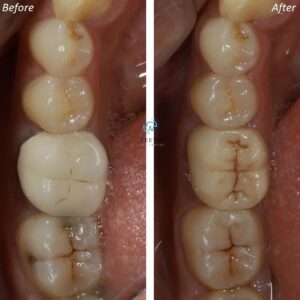
cosmetic tooth coloured filling restoration crowns best aesthetic dentist india ahmedabad satellite denal clinic porcelain veneer smile designing (4)Solid /Monolithic zirconia: They are opaque generally for posterior teeth, making it durable to withstand forceful chewing and grinding. They are effective for masking highly discolored dental restoration such as post n core or restoring dental implants.
Layered zirconia: They are more translucent and opalescent, unlike solid zirconia, it is especially suitable for anterior crowns. Although if enough clearance is present can be used for posterior teeth.
> These crowns are 100% metal-free, prevent gingival darkening, and remove the possibility of exposing metallic margins if gum recedes.

Teeth Care Centre®: has a highly talented cosmetic dentist which render beautiful smiles by fabricating life like crowns. Based on your individual requirement, our team of dental professionals help you to select the right type and material of crown for you, so that you get the amazing radiant smile.
CAD/CAM technology: – Teeth Care Centre is equipped with modern instruments and incorporates the latest dental technologies in the clinic and therefore we use the latest CAD/CAM technology to design and fabricate custom inlay/onlay/crowns. This means you can leave the dental office with a fully aesthetically restored tooth.
Digital impression: – We also provide digital impression to fabricate prosthetic restorations like inlays, onlays, copings and frameworks, single crowns and bridge to achieve more precise and accurate prosthesis. Moreover, these scanners are time-efficient (by reducing significant time to transport plaster models to dental lab), eliminates plaster model errors and allows better communication with the dental technicians, which in turns helps to fabricate the prosthesis faster, with very high accuracy and with exact shade matching.
Dental Laboratory support: TCC is associated with India’s best laboratory technicians to provide the highest quality dental restorations, crown and veneers delivered in a timely fashion with attentive services. We strive to provide the perfect blend of technical expertise with artistic hand and natural like shade matching along with maintaining the contour to amalgamate with the natural teeth.
Top brands of tooth coloured restoration used in Teeth Care Centre are:
3M- USA; Ultradent-USA; Ivoclar-Liechtenstein; Coltene-Switzerland; GC-Japan; Dentsply-USA; VOCO-Germany; Sirona-Germany.
These have unique technology for excellent aesthetics and low wear; strong long-lasting and natural looking results; addressing the opacities and translucencies of both dentin and enamel and allow better blending with natural tooth colour; great fracture toughness, strength and wear resistance.

Dental Crown and Bridge Cost in Ahmedabad at Teeth Care Centre:
PFM Crown: 18000
Zirconia Crown: 23500
Gold Crown:27000
*Price in Indian Rupees

Dentures

Denture is the prosthetic device used to replace the missing teeth and restore their structure and function. They either replace all the teeth or set of missing teeth depending on denture type. Denture enables you to speak and eat more comfortably. They prevent facial muscles from sagging and impart an overall younger look to you. Following are the type of dentures:

Full Dentures: These dentures replace all the teeth in the mouth. These can either be Biofunctional Prosthetic System (BPS) Dentures, Lucitone dentures or regular dentures.

BPS Dentures: These dentures ensure that the aesthetic demands of the patient are fulfilled with its set of Ivoclar Vivadent set of teeth which resemble the natural teeth and help to recreate your lost smile. They are customised according to your needs and requirements and precisely fit onto the gums without snapping. They enable you to consume the food of your choice without creating any sort of hindrance. Besides rendering excellent aesthetics, these dentures also restore the function of the natural teeth.

Lucitone dentures: These dentures are made with lucitone denture base resins which is high impact denture base resin which resists any sort of breakage. It is highly aesthetic with balanced translucency and excellent vein simulation.

However these dentures cannot be used in patients who have strong gag reflexes or are allergic to the monomer present in the denture base resin.

Partial Dentures: These removable dentures used to replace one or more missing natural teeth and thereby prevent the adjacent remaining teeth from shifting, restores function and aesthetics. Following are the types of partial dentures.

Flexible Partial Dentures: They are the type of partial dentures which are extremely comfortable on wearing owing to their flexible nature. Flexible denture is the ideal choice for patients allergic to the acrylic resin. They are light in weight and provide a more realistic look. They restore the structure and functions of the missing teeth and prevent adjacent teeth from shifting. However, these dentures are more prone to the bacterial attack, and hence need to be cleaned frequently.

Cast Partial Dentures: It is a removable type of partial denture which consists of a cast metal framework, which contains artificial teeth set in acrylic resin. These dentures are more retentive, much stronger and durable. However, this denture is very fragile and almost impossible to repair once damaged.

Implant Dentures: These dentures are supported by and attached to the implants. These can either be fixed or removable depending on the type.

Implant Supported Fixed Dentures: These dentures are fixed to the permanent implants providing a more secure and confident fit. They enable you to eat and speak properly without slipping away. It replaces all the missing teeth and increases your self-confidence. These dentures may however lead to food lodgement if not cleaned properly.

Implant Supported Removable Dentures: These dentures can either be bar retained or ball retained.
I.Bar Attachment Denture: This denture involves placement of 4 to 6 implants depending on the size of the jaw. Thin metal bar that follows the curve of your jaw is attached to these implants using clips or other types of attachments. The customised denture is then fitted over the bar clipped into place by the attachments. This denture can be removed for cleaning and maintenance.
II.Ball Attachment Denture: This denture snaps onto the implants placed into your jaws. The attachments on the implants are ball-shaped which fit into the sockets of the denture. It thereby helps you to chew food without sliding away. It is not as stable as the bar retained denture and still has the ability to move.

Teeth Care Centre® has wide array of options to suit your requirements, so that one can eat favourite food without worrying.

Inlay and Onlay

Inlay is an indirect (laboratory made) restoration used to restore posterior decayed or damaged teeth, in which the damaged portion is too extensive to be treated with simple filling. It will incorporate and restore chewing surfaces of the teeth between the cusps.

While onlay is an indirect (laboratory made) restoration which is used to restore posterior decayed or damaged teeth, in which the damaged portion is not extensive enough to need a full coverage crown. Onlays will restore and incorporate one or more cusps.

Based on the nature of material used in their fabrication, inlays can either be gold type, porcelain type, composite type and zirconium type. Porcelain, zirconium and composite inlays are much more aesthetically appealing than the gold ones due to their close resemblance to the natural tooth colour.

Inlays and onlays do not require removal of healthy portion of tooth and thus helps in preservation of natural tooth structure. Porcelain and zirconium inlays do not chance colour over time and are aesthetically appealing. Margins of both inlays and onlays are kept minimal which makes them easier to clean and further help in maintaining proper oral hygiene. Moreover they restore and strengthen the damaged tooth.

Teeth Care Centre® are known to incorporate latest dental technologies in our clinic and therefore we use the latest CAD/CAM technology to design and fabricate a custom inlay or onlay. This means you can leave the dental office with fully aesthetically restored tooth.

Implant Prosthesis

SELECTION GUIDE FOR SINGLE OR MULTIPLE IMPLANT PROSTHESIS:

The selection of abutments are based on the following factors

Colour:
TOOTH COLOURED ABUTMENTS:
These abutments are preferred in the front teeth aesthetic zones, owing to their tooth coloured nature.

METAL ABUTMENTS:
These abutments are not aesthetic and are generally used in the back teeth region.

Connector:
SCREW RETAINED:
PROS:
– Easily retrievable
– Easy to tighten the screws if the prosthesis becomes loose
– Abutment removal during maintenance of implant is possible
CONS:
– Chances of composite coming out of screw access hole or getting stained over time
– Less aesthetic due to visibility of filled screw access hole on occlusal surface

CEMENT RETAINED:
PROS:
– These abutments are generally preferred in the aesthetic zones since they appear aesthetically pleasing
CONS:
– Not easily retrievable and in cases of loosening of abutment screw – new prosthesis needs to be fabricated.
– Excess cement can extrude into the sulcus and can damage the peri-implant tissues.

Fabrication
This choice is solely decided by the dentist based on the requirement.

STOCK ABUTMENTS:
Stock abutments are the ideal choice of abutments for most cases. They come in standardized sizes for bone and tissue level implants. They are user-friendly and are often an economical choice. Straight and angulated are the two kinds of stock abutments available.
One more type of stock abutment is Multi-Unit abutment which is used in specific cases. Multi-Unit abutments are designed for angle corrections and provide positive uniform seat for screw retained implant restorations.
With stock abutments, sometimes it is also not possible to control the final margin for the placement of crown.

CUSTOM ABUTMENTS:
Custom abutments are suitable for cases which are not ideal for the stock abutments. They can provide more predictable aesthetics and superior tissue management than stock abutments. They are highly efficient but more costly.

SELECTION GUIDE FOR FULL MOUTH IMPLANT PROSTHESIS:
Implant dentist will decide full mouth implant prosthesis basis on number of implants, position of implants and for long term implant health.

 Overdenture:
FRAME MATERIAL: Acrylic
TEETH MATERIAL: Acrylic
PROS:
– Easy to remove for cleaning
– Can hide aesthetic problems such as severe bone loss and tissue loss
– Light weight
– Less expensive
CONS:
– Removable which some people don’t like
– Acrylic can stain if abrasives are used to clean
– Can chip overtime
– May move or rock a little bit in mouth

Hybrid Bridge:
FRAME MATERIAL: Titanium or Cobalt Chromium
TEETH MATERIAL: Acrylic
PROS:
– Fixed option: comfortable and feels like natural teeth
– Light weight: if titanium as a frame structure
CONS:
– Heavy weight: if cobalt chromium as a frame structure
– Acrylic can stain if abrasives are used to clean
– Can chip overtime

 Malo Bridge
FRAME MATERIAL: Titanium/ BioHPP/ Zirconia
TEETH MATERIAL: Porcelain or Composite
PROS:
– When implants are not in ideal position
– Fixed option that looks and feels like natural teeth
– No staining – if porcelain used as a teeth material
CONS:
– Chances of staining – if composite as a teeth material
– Costly

Titanium Bridge:
FRAME MATERIAL: Titanium
TEETH MATERIAL: Porcelain or Composite
PROS:
– Good strength
– Light weight
– Biocompatible
CONS:
– Costly

Zirconia Bridge:
FRAME MATERIAL: Zirconia
TEETH MATERIAL: Porcelain
PROS:
– Good strength
– Will not stain overtime
– Tooth coloured framestructure- looks and feels like natural teeth
– Less likely to chip or break, if full contoured zirconia
CONS:
– More costly
– Full contour zirconia lacks translucency – so prosthesis can look little opaque
– Full contour zirconia with custom porcelain overlay has good aesthetics but has chances of fracture
– If zirconia is not pure, then its carcinogenic
– If cement retained crown, then has less strength

 PEEK/ BioHPP Bridge:
FRAME MATERIAL: PEEK/ BioHPP
TEETH MATERIAL: Composite
PROS:
– Very light weight
– Good shock absorber
– Feels more like natural teeth
– High aesthetics
– Highly biocompatible
– Good chewing efficiency
– Minor intraoral maintenance possible
CONS:
– More Costly
– More maintenance required
– More chances of plaque accumulation

 Cobalt Chromium Bridge:
FRAME MATERIAL: Cobalt Chromium
TEETH MATERIAL: Porcelain or Composite
PROS:
– Good strength
– Economical
– Good bond to ceramic
CONS:
– Very heavy weight
– Carcinogenic if contains beryllium

In any type of implant prosthesis, regular maintenance by patient is must for long term implant success.

Full Mouth Reconstruction

Click Here – Teeth Care Centre® Full Mouth Reconstruction Guide
It refers to rebuilding or replacing all the damaged and problematic teeth in the mouth with revised and augmented restorations or prosthesis, which results in fully functional and aesthetically pleasing teeth, gums and jaws.

A full mouth reconstruction is indicated when there are multiple dental problems like poor facial appearance, lack of functionality and speech hindrances. Apart from difficulty in eating and speaking, poor oral health also brings social embarrassment. Full mouth reconstruction is indicated when there are one or more of the dental issues like multiple missing teeth, trauma to the mouth , worn and torn out teeth , multiple decayed teeth, dislodged or fractured fillings, weak or discoloured teeth, misaligned teeth, gummy smile or in case of extensive gum infections.

Full mouth reconstruction needs personalized care. Our team of highly qualified and skilful dentists will suggest a best suited treatment plan which addresses all your major concern after thorough examination and legitimate evaluation. This is a complex procedure and requires an artistic vision to restore your smile to full health and beauty. The consultation will include clinical examination, radiographic analysis, cast analysis, and photographic analysis. An award winning Teeth Care Centre® is equipped with latest technology which provides rapid, accurate diagnosis and treatment with high level comfort.  A precise diagnosis forms the base of your treatment. The success rate of treatment is directly influenced by the diagnosis and treatment planning. Our doctors having years of experience down reached knowledge of their subject work towards providing high calibre treatments.

Generally we choose painless non-invasive procedures whenever possible. Following are some of the treatment options enlisted we consider for full mouth reconstruction.

Routine procedures: first step in full mouth reconstruction is routine procedures like filling, teeth whitening, teeth cleaning, flap surgery, and root canal treatment.

Crowns and bridges: Crowns and bridges are fixed prosthesis that is cemented on the existing teeth, implants or root canal treated teeth. They are used to entirely cover or ‘cap’ a damaged tooth or to cover an implant. Besides strengthening the damaged tooth, crowns also improve aesthetics, shape, alignment and occlusion of the tooth. After loss of a tooth, the rest of the teeth move and create a space, which hinders the normal dental occlusion, causing a bad bite. Fabrication of crowns and bridges help prevent the development of bad bite. Good quality crowns like Zirconia or E-Max crowns live for decades without giving you any discomforts.

Veneers : These are custom made, wafer thin layers of tooth coloured material placed on the front surface of a chipped, stained, abnormally placed or crooked tooth to improve the colour, shade, size and overall appearance of the tooth and to protect the tooth from damage. Veneers are impervious to staining so you’ll always have your pearly whites being white as ever.

Braces and aligners: Correction of malocclusion is of critical importance when it comes to full mouth restorations. Apart from bestowing our patients with a precious smile, teeth alignment brings back the teeth to their spatial positions. When the teeth are finally where they are supposed to be, the patient will be relieved of many dental problems, main being correction of the bite.

Implant:  Implant is a replacement for root of the tooth which is embedded into the jawbone beneath the gums in order to replace missing tooth in the oral cavity. It provides support for the artificial teeth as well as dental bridges and dentures owing to its stability. Implants are great alternatives for people who aren’t ideal candidates for ordinary bridges and dentures due to poor ridges, gagging or sore spots.

Temporo-Mandibular Disorder

Click Here – Teeth Care Centre® Temporomandibular Joint Disorder Treatment Guide
TMJ is the Temporomandibular joint which connects jaw to the skull. This joint is responsible for opening and closing of the mouth as well as side to side movements of the jaw. Any group of disorders that cause disruption in the chewing system including the teeth, jaw muscles, jaw joint or the jaw bone are termed as temporomandibular joint disorders.

Difficulty in opening and closing of mouth, pain or tenderness during jaw movement, difficulty in chewing, pain in and around the ear, facial pain, muscle spasms around the jawline, deviation on opening, crepitus, limited opening, painful opening, locking of the joint or popping sound on mouth opening are some of the symptoms indicative of temporomandibular joint dysfunction.

There are number of treatment options available for TMJ pain relief ranging from certain medications in case of mild cases to surgery for extremely severe cases. Some of the treatment options used for mild to moderate cases are as follows:

Over the counter Medication: Certain non-steroidal anti-inflammatory can provide relief from muscle pain and swelling.

Application of moist heat or ice packs: Application of moist heat using a warm washcloth or ice pack on the side of the face where the pain is felt can reduce the swelling and relief from the jaw pain.

Splint or night guard: These are custom made plastic trays which fit over your upper and lower teeth in order to prevent them from coming in contact. Thus, they make it difficult for you to clench or grind your teeth and thereby help to treat patients with TMD.

Transcutaneous electrical nerve stimulation (TENS): This treatment uses low-level of electrical currents to relaxing the jaw joint and facial muscles, thereby relieving the pain.

Biostimulation: This procedure uses laser which is found to provide temporary relief from the jaw pain. We have incorporated the latest laser BIOLASE into our clinic. This laser penetrates deep into the tissues and provides therapeutic warmth to cease the minor pain and discomfort in the joint.

Trigger-point or Botox injections: Anaesthesia is injected into facial muscles called “trigger points” while botox is injected into the jaw muscles used for chewing to relieve the jaw pain.

Surgery is often the last resort when other treatment options fail. It is used to treat severe cases of temporo-mandibular joint disorders, which are not resolved using the above treatment options. At Teeth Care Centre®, we have highly qualified and skilled oral and maxillofacial surgeon who is well versed with temporo-mandibular joint disorders and only deal with TMD treatment. Our dental professionals do the thorough diagnosis of your case using temporo-mandibular joint arthroscopy (Arthroscopy is a minimally invasive diagnostic procedure performed using an arthroscope, which has a lens light and video screen attached to it). This enables us to examine your joint and design a suitable treatment plan. Following are some of the surgical approaches undertaken to treat severe cases of temporo-mandibular joint disorders.

Arthrocentesis:  It is the procedure used in cases of locked jaw wherein needle are inserted into the joint in order to irrigate the jaw joint and flush out debris and inflammatory products.

Open-joint arthroplasty: It is a surgical procedure used to repair, reposition, replace, or remove parts of temporo-mandibular joint. Open joint arthroplasty is done in situations when the jaw pain doesn’t resolve with other treatment approaches.

Total joint replacement: In case of severe joint deterioration of TMJ commonly observed in arthritis, more extensive surgical process is needed to treat the condition. In this surgery joint is replaced with pre-fabricated or customised TMJ prosthesis called total joint replacement.

Mouth Guards and Splints

When certain terms are used interchangeably, it does not necessarily mean that they mean the same, such as the case with mouth guards and splints. Therefore it is imperative to know the difference between the two. Mouth guards are designed to protect your teeth from harmful blows while the splints are used to prevent unwanted teeth grinding or clenching.

Mouth Splints: It is a removable dental appliance designed to fit the biting surfaces of upper or lower teeth in order to reduce the grinding pressure transmitted on the teeth. It is used for the following purposes:

Temporomandibular joint Disorders: Splint therapy is one of the main options followed to provide relief from temporomandibular joint disorders. Occlusal splint therapy help in maintaining balance between neuromuscular system and the masticatory system. These splints protect TMJ discs from dysfunctional forces which lead to permanent displacements and damage, thereby helping to create a balanced occlusion. Occluding and non-occluding are the two main types of splinting. Occluding splints, also called stabilization splints which aid in improving the alignment between upper and lower teeth. Non-occluding splints on the other hand open the jaw, and prevent clenching of teeth.

Bruxism:  Bruxism is the habit of constantly grinding or clenching of the teeth. In bruxism, splint is mostly used during the night when the chances of undetected teeth grinding are high. It prevents teeth clenching and provides relief from the associated jaw pain, wear of teeth and soreness.

Sleep Apnea: Mandibular advancement splints work wonders in treating sleep apnea. They are designed to slightly push the lower jaw forward in order to keep airway open during the sleep.

Full mouth Rehabilitation: The Kois Deprogramming splint prevents interlocking of the teeth and therefore allows the patient’s lower jaw to gradually relax and settle into an ideal position with relation to the teeth. The Kois Deprogramming splint is a removable, plastic appliance that covers the hard palate and creates a single point of contact between the lower central incisor and the anterior bite plane. Used for evaluating the stability of a patient’s bite, the Kois Deprogramming splint is used to locate a patient’s optimal jaw position in full mouth rehabilitation.

Mouth Guards:  Mouth guards are the custom fitted dental appliances designed for mouth, in order to protect teeth, gums and lips. It prevents injury during contact sports and exercises.

Find out how our experienced dentist can help you to solve your concern.

Obstructive Sleep Apnea

Obstructive sleep apnea is the sleeping disorder caused due to partial or complete obstruction of upper respiratory tract during sleep. The obstruction of upper respiratory tract occurs when the muscles at the back of throat intermittently relax and collapse during sleep, thereby obstructing the airway. This intermittent relaxation of throat muscles causes breathing to frequently stop and start during the sleep.

Obstructive sleep apnea is most commonly characterized by loud snoring, in an attempt to breathe with an obstructive air passage. Moreover daytime drowsiness, morning headaches, high blood pressure, depression, irritability and extreme fatigue are some of the other symptoms indicative of sleep apnea. If left untreated, obstructive sleep apnea can be potentially serious leading to chronic heart disease, heart failure, stroke, diabetes and depression due to reduction in supply of oxygenated blood to the heart.

We treat obstructive sleep apnea with oral appliances like Tongue Retaining Devices which when worn during sleep, can prevent the collapse of tongue onto the air passage and provides an uninterrupted pathway for air to flow. We also provide oral appliances like Mandibular Advancement Devices to slightly push the lower jaw forward in order to keep airway open during sleep.

These appliances work wonders in treating sleep apnea so that it helps you and your partner in getting the sound sleep you deserve.

Oral Cancer Screening

Oral cancer screening refers to the examination performed by a dentist or doctor using simple tests to check for the signs of cancer or precancerous conditions in your mouth. Oral cancer kills thousands of people every year and for saving valuable life early diagnosis plays a very crucial role. This is where oral screening can make a difference by identifying mouth cancer at an early stage.

An early diagnosis can literally save lives. Recognizing possible warning signs of cancer and taking prompt action leads to early diagnosis. This increases the chances of successful treatment. Early diagnosis prevents further spread of cancer to other organs and it leads to high survival rate.

Oral Cancer is the abnormal, uncontrolled and aggressive cell growth seen at lip, inside lining of lip and cheeks, tongue, bottom of mouth, and the bony roof of the mouth, or hard palate. At Teeth Care Centre®, we have a team of highly qualified dental professionals who examine your mouth to check for presence of possible signs of cancer like white or red patches, mouth sores, etc. In case of any doubt, we have early detection kits to check it and in case of further need, an onco pathologist will take biopsy sample from the suspected oral site for more investigation. Biopsy investigation is the best method to determine the presence or absence of cancer.

Through regular checkups and periodic oral cancer screening, one can possibly curb this fatal disease before it spreads.

Stem Cell Banking

Stem cell banking can be a life saving decision for the entire family. Due to sedentary life style habits there has been an incline in number of ailments across the world. Secondly, it is impossible for mankind to prevent or heal all disorders, so it is crucial to preserve stem cell. Hence, stem cell banking is the ultimate saviour for future worries.

Stem cells are the master cells which can differentiate to form the similar cells, which replaces the cells that are worn out or damaged. Moreover, it can also adapt into varied forms such as brain cells, blood cells etc.

They are capable of treating various disorders such as:
-Blood cell disorders-Anaemia, Leukemia etc.
-Alzheimer’s disease
-Parkinson’s disease
-Muscular dystrophy
-Rheumatoid Arthritis
-Spinal cord injuries
-Stroke
-Healing of wound
-Skin disorders
-Cardiovascular diseases
-Liver disease
-Kidney disease
-Eye disorders
-Diabetes
-Crohn’s disease
-Autism
-Cerebral Palsy
-Tooth and Bone repair

They can be collected from various sites such as Dental pulp, Bone marrow, Umbilical cord tissue and Adipose tissue.

We at Teeth Care Centre® have established a junction with renowned stem cell bank so that we can facilitate all our patients with the extraction of stem cells from the dental pulp of milk teeth and/or from the pulp of the wisdom teeth.

If you have missed a chance to preserve cells during your birth, then tooth stem cell banking is the alternative for you.