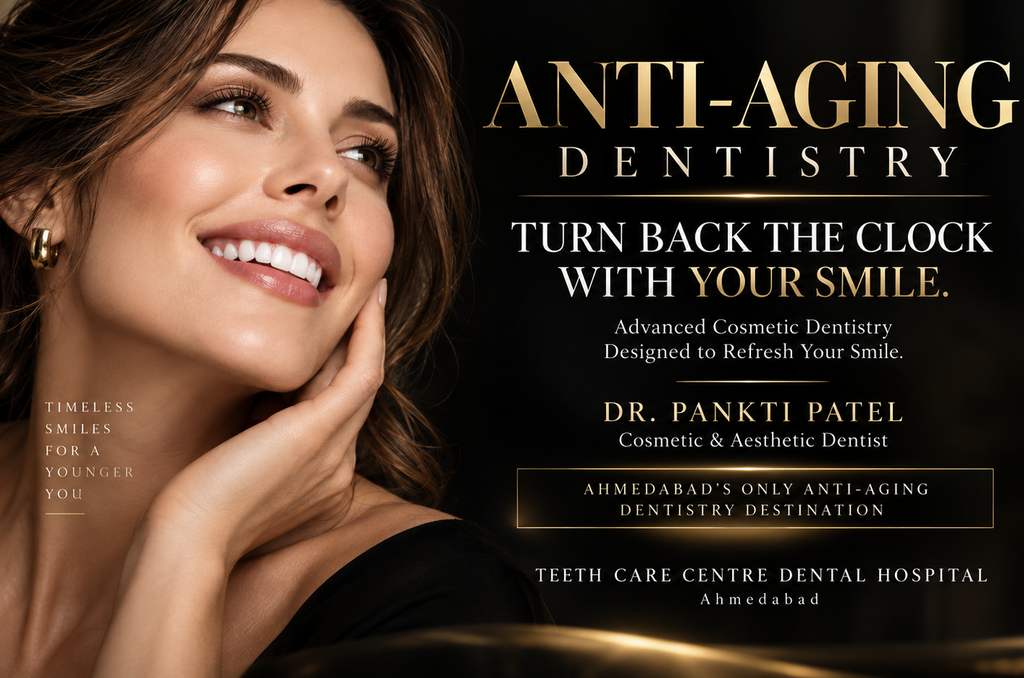
A youthful smile can transform the way your entire face looks, which is why anti-aging dentistry in Ahmedabad is becoming an important part of modern cosmetic dentistry.
Dr. Pankti Patel, Cosmetic & Aesthetic Dentist, brings together advanced cosmetic dentistry, smile design and aesthetic dental treatments to create naturally beautiful, harmonious smiles.
Anti-aging dentistry focuses on more than simply making teeth whiter; it considers tooth shape, proportions, colour, gum display, smile line and overall facial harmony.
With carefully planned smile makeovers in Ahmedabad, cosmetic dental treatments can help refresh an ageing-looking smile while maintaining a natural and sophisticated appearance.
At Teeth Care Centre Dental Hospital, Ahmedabad, every smile is approached individually, with treatment designed around the patient’s facial features, expectations and aesthetic goals.
For patients searching for an anti-aging dentist in Ahmedabad, the objective is not an artificial-looking smile, but a refined smile that complements the face.
Modern anti-aging dentistry in India combines aesthetics, function and digital treatment planning to create personalized cosmetic dental solutions.
From smile design and veneers to teeth whitening, tooth-coloured restorations and other advanced cosmetic procedures, treatment can be customized according to individual requirements.
A beautifully designed smile may improve the appearance of teeth while also creating a more balanced and refreshed facial appearance.
DR. PANKTI PATEL Cosmetic & Aesthetic Dentist
AHMEDABAD’S ONLY ANTI-AGING DENTISTRY DESTINATION
TEETH CARE CENTRE DENTAL HOSPITAL Ahmedabad
For people looking for a cosmetic dentist in Ahmedabad, anti-aging dentistry offers a modern approach to smile rejuvenation, combining dental science with sophisticated aesthetic principles.
The concept is simple: you do not need to change who you are—you can simply refresh your smile.
For those exploring anti-aging dental treatment in Ahmedabad, Dr. Pankti Patel and the Teeth Care Centre Dental Hospital team focus on creating elegant, natural-looking smiles designed to complement each patient’s unique appearance.
Anti-Aging Dentistry — Turn Back the Clock With Your Smile.
HOW TO CHOOSE THE BEST DENTIST FOR YOUR NEEDS? The FIRST CRITERION in selecting the right dentist is to observe the dentist’s own smile. A dentist with a bright, well-aligned, and healthy smile reflects their commitment to oral aesthetics. If a dentist does not prioritize his/her own smile, how can they ensure the best results for yours? The SECOND CRITERION is to evaluate their qualifications, experience, and expertise. Check their educational background, professional degrees, and specialization in relevant fields. A highly qualified and experienced dentist is more likely to provide superior treatment and care. The THIRD CRITERION is clinic’s hygiene standards, technology, patient reviews, and communication skills to ensure a comfortable and effective dental experience.
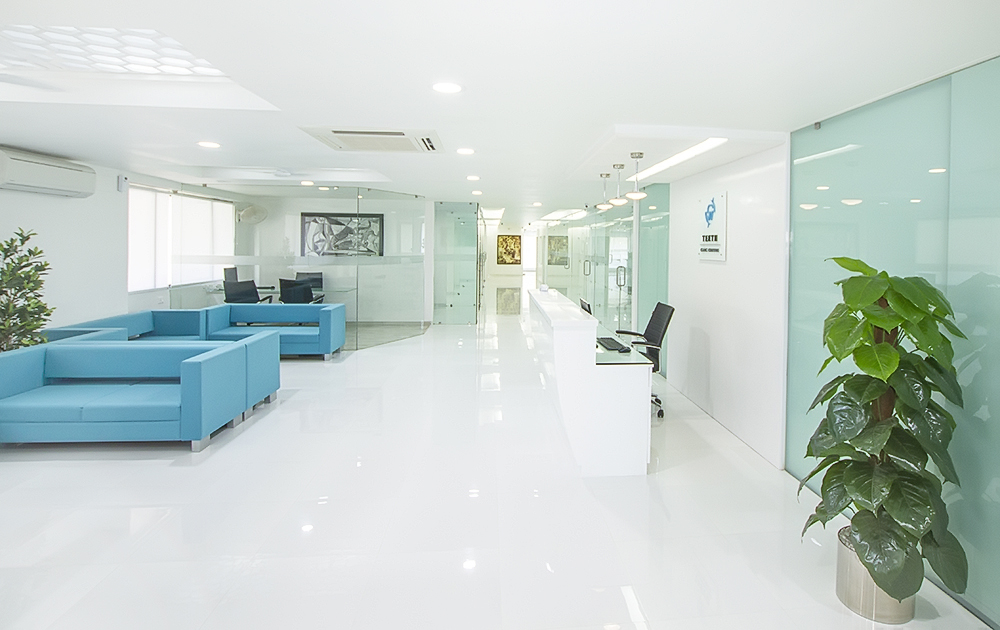
WHY CHOOSE US: We are a combination of ULTRA-MODERN SETUP and OLD PHILOSOPHY OF PATIENT CARE. We are Gujarat’s No.1 ultra-modern high-tech dental clinic. As we believe in the old philosophy of ‘relationship matters’ and that’s why we do not have multiple clinics, we have Single Location Clinic. We know all our patients personally and their needs, and that’s why we try to give them the individualized highest level of quality care possible. Relationship with our patients, their overall experience at our clinic, best quality treatment, and superior technology; this approach make us different from others. Luvot® group is serving healthcare since 1949. Teeth Care Centre (TCC) Hi-Tech Dental Clinic in Ahmedabad, an ISO 9001:2015 Certified multispecialty dental clinic with international standards, latest technology and an eco-friendly concept delivers exceptional and valuable comprehensive dental care to all its clients that will result in a beautiful and long-lasting smile. TCC offers a wide range of painless dental procedures. Our crowning achievement is to provide an exquisite and shining smile to our elite clients.
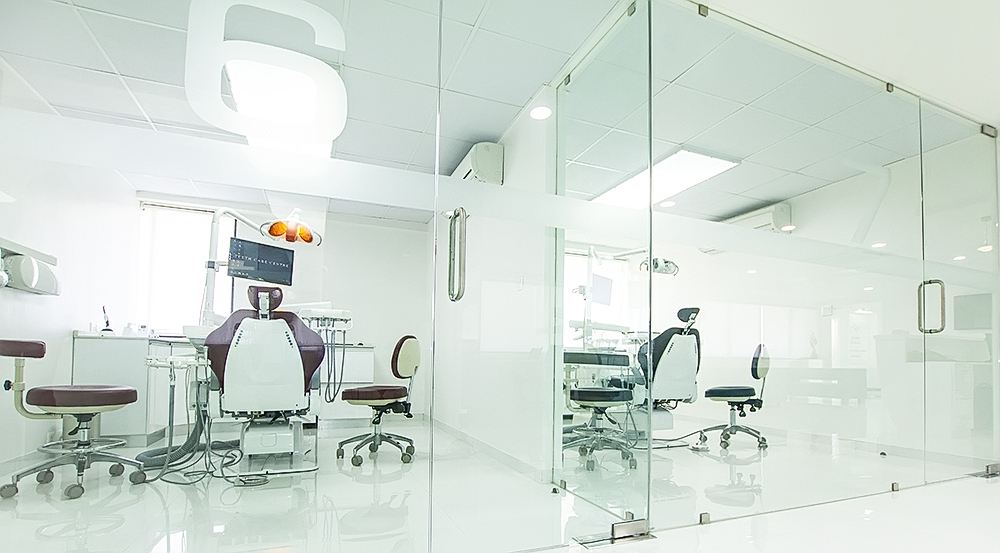
International Standard: TCC No.1 Dental Clinic in Ahmedabad provides world-class dental facilities and is committed to delivering the finest quality dental care using the latest state-of-the-art technology. We assure you of providing a comfortable, pleasant, and anxiety-free environment. Our office is well equipped with ultramodern and internationally approved materials and equipment so that patient care is at the maximum. We strictly adhere to the international protocol of infection control and sterilization to protect our clients from the risk of cross-infection. Our staff is friendly, knowledgeable, and ready to assist you with any queries you may have. To give you the best possible services and results, we are committed to continual education and learning. You will receive extraordinary service and individualized care that is unsurpassed. TCC is an ISO 9001:2015 certified dental clinic.
Latest Technology: TCC No.1 Dentist in Ahmedabad believes that when new dental technologies are being introduced every day, it doesn’t make any sense to stick to the past. So, we have ultramodern dental equipment with advanced and latest technology. At TCC, we use dental applications, materials, and equipment manufactured by leading and renowned companies from around the world to ensure that our client receives the highest possible standards of dental care available today. We are equipped with advanced Computerized Software, Digital Imaging Systems which give maximum benefit with minimum harm to our clients. We also accomplish Nanotechnology for the greater comfort to our clients. We are proud to bestow the audiovisual facility for patient education so that our clients can easily visualize the final outcome of treatment before the treatment starts. We associate ourselves with renowned and top-quality laboratories from across the globe for our dental work.
* Many clinics often claim to have ultra-modern technology, please do not rely them right away. Instead, kindly check whether the equipment they use are a world-renowned brand or substandard.
Eco-friendly: TCC is an environmentally friendly dental Hospital that emphasizes on our client’s dental wellness. We integrate green practice effectively and efficiently in various aspects which include office design, furnishings, and dental processes to make our client’s experience serene and tranquil. Our staff is dedicated to providing you with personalized dental care in a placid, relaxed environment that promotes general well-being and health. Our patient’s overall health is extremely important to us so we provide eco-friendly dental care by using – – Biocompatible dental materials. – Less hazardous X-ray system – Environmentally sound disposal of waste – Steam-based sterilization – Energy-efficient compact lights. – Cloth in operatory and sterilization instead of disposables.
OUR TEAM: TEAM APPROACH: TCC comprises of well-qualified dental professionals and master’s degree holders from different specialties who are dedicated to preserving and restoring your oral health beautifully. We bring together and harness the rich and wide experience of the best dentists the field has to offer. This brings in the unique comprehensive Diagnostic Approach that allows us to examine the treatment possibilities from different angles. Our exceptional and eminent team of 20 dentists from India and abroad works to ensure that our clients receive the most advanced dental care available.
Dr. Nirav Patel B.D.S., M.D.S. (Orthodontics), Ph.D., LL.B. F.O.I., F.P.F.A. Orthodontist, Implantologist, Cosmetic Dentist Dr. Nirav Patel is a managing director of TCC and a driving force behind it. He is determined to give you the smile you deserve. He takes pride in helping you achieve your dream smile by giving red-carpet treatment to his clients. He is graduated from Bharati Vidyapeeth University, post-graduated in Orthodontics with honors from Maharashtra University of Health Sciences, and received a Ph.D. degree from Pacific University. Dr. Nirav Patel is Gujarat’s first Ph.D. Orthodontist. He has completed his advanced cosmetic program at New York University College of Dentistry and Smile Care. He has been honored with a fellowship from the Pierre Fauchard Academy. He has also earned his Fellowship in Oral Implantology from Nobel Biocare. He has done basic and advanced lingual orthodontic training under Dr. Rafi Romano, Israel. He has taken advanced training for Invisalign under Dr. Thiti Sirikrai. He is one of the most distinguished and eminent orthodontists, Implantologist, and Cosmetic Dentist. He is a dynamic doctor with most brilliant ideas, a sympathetic attitude, and a deep-rooted sense of dedication to duty. He has undergone numerous advanced pieces of training to further sharpen his professional skills. He attends regularly several significant seminars, symposia, workshops, programs, and conferences on different topics and acquires valuable knowledge of the latest developments. Dr. Nirav Patel is globally recognized as an excellent clinician. Apart from being a remarkable doctor, Dr. Nirav Patel is also a passionate teacher and clinical researcher with more than 10 years of teaching experience in dental college. Dr. Patel is specialized in Invisible braces. He has been trained extensively in various techniques of invisible orthodontics. He is the leading provider for Invisible braces (Invisalign) not only in Ahmedabad but Gujarat. He is associated with the following prestigious dental organizations: – World Dental Federation (Switzerland) – American Dental Association (USA) – Indian Dental Association – Indian Orthodontic Society – Indian Society of Oral Implantology – Indian Academy of Aesthetic and Cosmetic Dentistry – Gujarat Orthodontic Study Group – Dental Practitioner’s Society – Ahmedabad – International Association for Orthodontists & Implantologists – Eco Dentistry Association (USA)
Dr. Pankti Patel Chief Dentist B.D.S., M.D.S. (Oral Diagnosis) D.L.D., F.I.S.O.I., F.D. Cosmetic Dentist, Implantologist, Laser Dentist Dr. Pankti is a chief dentist of Teeth Care Centre Dental Hospital. A vivacious and friendly dentist of Ahmedabad at TCC strongly believes that every client walking out of the clinic should go with a smile on their face. Dr. Pankti Patel earned a Master’s degree in Oral Medicine and Radiology. She is a master in the diagnosis of various oral diseases. Diagnosis is the backbone and crucial step in the treatment plan, so she always focuses on the perfect diagnosis and further leads to the best treatment along with a team of doctors working with her. She has been awarded Diploma in Laser Dentistry from IALD-RWTH Aachen University, Germany. She is a Fellow of the Indian Society of Oral Implantologists. She has also done her fellowship in clinical research from ICDRO Bilcare Research Academy. She has been extensively trained in Advanced Implant Prosthodontics, Full Mouth Rehabilitation and Contemporary Comprehensive Dentistry under Dr. Ali. She is also trained for Porcelain Veneers under Dr. Galip Gurel, Turkey. She is a certified dentist in Ahmedabad for nitrous oxide sedation and is highly trained in providing safe and effective minimal sedation. She is also certified by Digital Dentistry Institute, USA for Advanced Full Arch Implant Prosthetics. She is a young dynamic dentist in Ahmedabad with a special interest in general and laser dentistry. She combines her scientific background with an artistic eye to bring the highest quality of personalized care to each of her clients. Dr. Pankti is a caring, gentle, and understanding professional. She continuously keeps abreast of the latest advances and developments in the field of dentistry. She is a member of several professional organizations like: – World Dental Federation (Switzerland) – American Academy of Cosmetic Dentistry (USA) – International Congress of Oral Implantologists (USA) – Indian Dental Association – Indian Academy of Aesthetic & Cosmetic Dentistry – Indian Academy of Laser Dentistry – Indian Society of Oral Implantology – Red Cross Society – Dental Practitioner’s Society- Ahmedabad
AWARDS: We are honored with many national and international prestigious awards. Teeth Care Centre: – KKP INTERNATIONAL EXCELLENCE AWARD 2023 for Best Customer Choice Hospital. – CUSTOMER SERVICE AWARD – 2013 from WhatClinic.com, Ireland. – No.1 DENTAL HOSPITAL IN GUJARAT – 2015 presented by National Business and Service Achievers Award at New Delhi. – INTERNATIONAL GOLD STAR AWARD for excellent performance & outstanding contribution for the progress of the nation & worldwide at Dubai(UAE). – GLOBAL BUSINESS AND SERVICE EXCELLENCE AWARD presented by Prime Time Research Media for Best Dental Care Centre in Gujarat at New Delhi. – EXCELLENCE IN DENTISTRY AWARD presented by Famdent for Best Clinic Interiors at Mumbai. – No.1 DENTAL HOSPITAL IN INDIA – 2017 presented by Katalyst Research – B.D.H. Award at New Delhi. – MOTHER TERESA EXCELLENCE AWARD presented by ICSEP for outstanding achievements at Bangalore. – CUSTOMER SERVICE AWARD – 2014 from WhatClinic.com, Ireland. – HEALTH ICON OF AHMEDABAD – 2018 presented by TOI Group at Ahmedabad. – HIGHLY COMMENDED NEW PRACTICE OF THE YEAR AWARD presented by Famdent at Mumbai. – NATIONAL HEALTHCARE ACHIEVERS AWARD presented by Praxis Media at New Delhi. – NATIONAL HEALTHCARE AWARD 2018 presented by Eminent Research at Mumbai. – CLINIC OF THE YEAR AWARD-2015 presented by Famdent at Mumbai. – TRUSTED IMPLANT CLINIC 2018 presented by DentalImplantsFriends.com, USA. – GUJARAT BRAND LEADERSHIP AWARD 2019 presented by WHWCA for Best Healthcare.
Dr. Nirav Patel: – Fellowship of the PIERRE FAUCHARD ACADEMY. – Fellowship in Oral Implantology from NOBEL BIOCARE. – RealSelf 500 AWARD presented by RealSelf, USA for one of 500 doctors in the world. – INDIAN ACHIEVERS AWARD FOR CHIKITSAK RATAN presented by the GSHEG at New Delhi. – BHARAT VIKAS RATAN AWARD with Medal presented by All India Business Development Association at New Delhi. – RAJIV GANDHI EXCELLENCE AWARD presented by IBC at Delhi. – DHARTI GAURAV AWARD presented by DVM at Ahmedabad. – RASHTRIYA PRAGATI AWARD with Medal presented by AIBDA for excellence in field of dentistry. – TRUSTED IMPLANT SURGEON 2018 presented by DentalImplantsFriends.com, USA.
Dr. Pankti Patel: – BEST DENTIST GUJARAT – 2021 presented by Healthcare Leadership Award by Eminent Research at Mumbai. – Fellowship in clinical research from ICDRO Bilcare Research Academy. – EMERGING DENTIST OF THE YEAR – 2014 presented by Health Care Excellence Award at Mumbai. – DENTIST OF THE YEAR AWARD – GUJARAT presented by T.E.H.E.G.at Delhi. – RASHTRA PRATIBHA PURASKAR presented by I.C.S.E.P. at Hyderabad. – BHARAT EXCELLENCE AWARD presented by Friendship Forum at Delhi. – INTERNATIONAL GLORY AWARD presented by Friendship Forum(Regd.) at New Delhi.
TESTIMONIALS: Click Here to see testimonials from some of our patients.
We have clients from around the globe.
DENTAL TOURISM: Thousands of people living in this world wish to get excellent dental services without spending their entire life savings. Dental treatments are very costly in their own country as compared to others and so the concept of dental tourism is gaining popularity day by day through which patients can receive dental treatments of the same quality from expert and experienced dentists. India is a preferred dental tourism destination for their exclusive qualities like internationally acclaimed medical standards, superior services, best and latest infrastructure and equipment, skilled and compassionate dental surgeons, and well-trained paramedical staff. Teeth Care Centre Dental Clinic in Ahmedabad with International Standards, Latest Technology, and an Eco-Friendly concept offers travelers from all across the world, unique and cost-effective dental care plans that fit into their itinerary. You can enjoy your vacation by visiting many beautiful and excellent historical cities and places of India along with your family or friends and simultaneously receive all kinds of routine and specialized dental services at your convenience. We provide exclusive tailor-made services to all our overseas clients as they are unfamiliar with the lifestyle, climate, and food of India. Our dedicated staff takes efforts to make your stay the most comfortable and satisfactory as per your expectations. POINTS TO CONSIDER BEFORE CHOOSING TREATMENT ABROAD: Click Here
CONTACT US: TEETH Care Centre Dental Hospital 2nd Floor, Pushpak66, Near Someshwar Jain Temple, 132ft Ring Road, Satellite, Ahmedabad, Gujarat, INDIA – 380015. Email: info@teethcarecentre.com Opening Hours: Monday to Saturday 9:00 A.M to 5:30 P.M Slot (45 min)Booking Charge (Refund in Treatment): Old Patient: 1000, New Patient: 3000, Second Opinion: 5000 & Emergency: Double (INR) Phone: +91 9377783384 | +91 7878783384
* We have a fixed price policy for all treatments: Price is fixed and transparent.
At Teeth Care Centre®, we believe in transparency – our pricing is fixed and remains the same for everyone, regardless of their financial status. We do not charge different amounts for the same treatment based on a person’s wealth. Ethical concerns: We consider this practice as unfair and unethical, as it essentially charges different prices for the same product or service based solely on someone’s financial status.
High-end Dentistry Video
Latest Pediatric Dental Care Update 2026: Preventing Early Childhood Cavities with a Child-Friendly Dentist in Ahmedabad Healthy baby teeth play an important role in chewing, speech development, and maintaining space for permanent teeth, making early dental care valuable even before a child has a full set of teeth. Parents searching for a child dentist Ahmedabad families can trust should look for a clinician who explains oral health in age-appropriate language and helps children feel comfortable during visits. A child’s first dental appointment is generally recommended by the first birthday or within six months after the first tooth appears. Early visits allow the dentist to check tooth development, discuss feeding habits, and identify risk factors for early childhood tooth decay. At a child dental clinic Ahmedabad parents visit, the appointment may include advice on brushing, fluoride use, pacifier habits, and reducing frequent exposure to sugary drinks. Parents can begin cleaning a baby’s gums gently before teeth erupt and use a soft, age-appropriate toothbrush once the first tooth appears. A tiny smear of fluoride toothpaste, approximately the size of a grain of rice, is generally recommended for children younger than three years, with a pea-sized amount for children aged three to six, under adult supervision. Parents should encourage children to spit out toothpaste when able and avoid swallowing excessive amounts. Night-time feeding habits also deserve attention because frequent exposure to milk or other drinks containing sugars can contribute to decay, especially when teeth are not cleaned appropriately. A pediatric dentist Ahmedabad families consult can assess whether a child would benefit from fluoride varnish or dental sealants based on age and cavity risk. Sealants are protective coatings placed on the grooves of selected back teeth, where food and plaque can accumulate. They do not replace brushing, fluoride toothpaste, or regular examinations. Some children develop white spots, brown areas, sensitivity, or visible holes in their teeth, which may indicate early or established decay. Because cavities can progress without obvious pain, parents should not wait for a child to complain before arranging an examination. A kids dentist Ahmedabad parents choose may use tell-show-do techniques, positive reinforcement, and short explanations to build cooperation during treatment. For anxious children, gradual familiarization with the dental setting may help make future appointments easier. Painless child dental treatment Ahmedabad clinics aim to provide depends on the procedure, the child’s needs, and appropriate pain-control methods; no responsible clinician can promise that every treatment will be completely sensation-free. If a cavity requires treatment, the dentist should explain the options to the parent and, when appropriate, the child. Parents should also discuss dental injuries promptly, particularly if a permanent tooth is knocked out or a tooth becomes displaced after a fall. Thumb sucking and pacifier use are common in young children, but persistent habits as the child grows may influence tooth position and jaw development. The dentist can advise when monitoring or habit guidance is appropriate. A kids dental clinic Ahmedabad families visit should also offer practical guidance for children with special healthcare needs or difficulty tolerating oral care. Establishing predictable brushing routines and limiting frequent sugary snacks can make daily care easier. Regular dental reviews allow advice to change as the child’s teeth, habits, and risk factors develop. Early, supportive dental care helps children build confidence while giving parents practical tools to protect their child’s developing smile.